Employment and service sectors · DP078
Freelancers can build useful privacy practices without a large budget
Build a small set of maintainable privacy practices around the client workflows a freelancer actually runs.
Research cutoff: . This dated explainer is general information; check the linked instruments and your circumstances before acting.

A freelancer may not have a privacy team, but can still know where client information lives, why it is needed and who can open it. Those answers often matter more at the beginning than buying another dashboard.
Start with one workflow you use every week: a new enquiry, a project handover or invoicing. Make that path understandable and controlled, then extend the method to the next one.
Do not assume small means outside the framework
The future DPDP scope and responsibilities depend on the actual processing, not simply on business size. The personal or domestic exclusion in section 3(c)(i) concerns an individual’s processing for those purposes; paid client work is not automatically the same as a private household activity.
As of 22 October 2026, the relevant substantive duties are scheduled for 13 May 2027 under the commencement notification. Section 17(3) provides for specified notified relief for certain classes, including startups, but small size alone is not a blanket exemption. Check a claimed notification rather than assuming it exists.
This does not mean a sole practitioner needs the same organisation chart as a large company. It means the practical method should fit the work while the legal assessment remains accurate.
Know when you decide and when you follow instructions
For your own enquiries and invoices, you may determine the purpose and means. For a client’s customer dataset used only under their instructions, your role may be different. Section 2(i) and 2(k) distinguish those activities.
Write down the scope of a client assignment before accepting a data export. Ask what you need to deliver, which fields are necessary, where you may work on them, whether you may use another service and how the assignment ends. Avoid accepting a full production database when a smaller or synthetic example would do.
If the client asks for a new use, revisit the instructions. Permission to prepare a report does not automatically explain using the same customer information to demonstrate your services publicly.
A hypothetical freelance project
A freelance designer needs examples of a client’s invoice layout. The client offers an export of real invoices containing names, addresses and payment details. The designer asks for synthetic examples that preserve the layout and edge cases without using actual customer records.
For the limited real information genuinely needed to administer the project, the designer uses a separate client folder, protects the account and shares only the relevant deliverable. The designer checks that a preview link is not open beyond the intended audience.
At completion, the designer hands over the agreed files and reviews temporary copies. Records needed for invoicing or another applicable obligation are assessed separately from creative working materials. The client-data assignment has a defined ending rather than an indefinite folder on a laptop.
Make four controls easy to repeat
First, maintain a short record map: information, purpose, storage location, recipient and owner. For a solo business, the owner may be you, but the map still helps when you change devices or bring in help.
Second, protect accounts and separate access between clients. Use suitable authentication, remove unnecessary shared links and avoid shared credentials where individual access is available. These are practical security measures aligned with the categories in the future rule 6, not a claim that one setting guarantees compliance.
Third, explain collection in language that matches the work. A client contact form should not promise uses or rights processes you cannot actually carry out. Identify a reachable contact and keep the explanation current when a tool or purpose changes.
Fourth, plan retention and exit. The future section 8 framework and rule 8(3) with the Seventh Schedule require careful treatment of erasure and legal retention. Do not promise immediate deletion of every record or keep every file forever because storage is inexpensive.
Review your tools as part of the workflow
Cloud storage, invoicing, messaging and AI services can each receive information. Check what you send, which settings apply and whether the service’s role matches your instructions and obligations. Where the future processor-contract requirement in section 8(2) applies, a casual tool choice should not bypass the contractual assessment.
The recurring failure is creating a polished policy disconnected from everyday files. Choose one recent project and trace it from intake to closure. Fix the unnecessary collection, broad link or unexplained copy you can actually see. A routine you maintain every week is a stronger starting point than a large document that nobody, including you, can use.
Start with one manageable freelance workflow
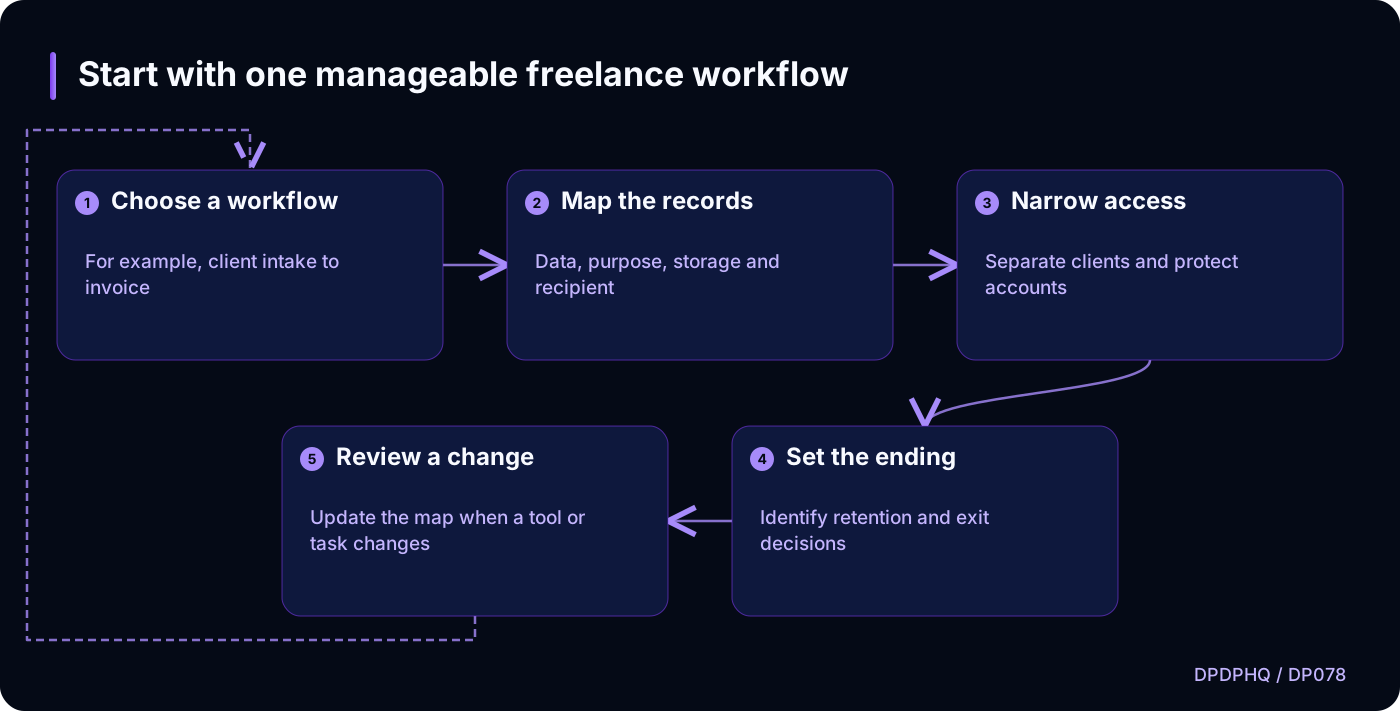
Text version of the diagram
- Choose a workflow: For example, client intake to invoice
- Map the records: Data, purpose, storage and recipient
- Narrow access: Separate clients and protect accounts
- Set the ending: Identify retention and exit decisions
- Review a change: Update the map when a tool or task changes
- Choose a workflow → Map the records
- Map the records → Narrow access
- Narrow access → Set the ending
- Set the ending → Review a change
- Review a change → Choose a workflow
Sources and reading context
These references support the original 22 October 2026 research. Source links and the date above make the scope of this article explicit.
- Commencement notification for provisions of the DPDP Act · paragraph (c)
Dates substantive duties
- Digital Personal Data Protection Act, 2023 · sections 2(i), 2(k), 3(c)(i), 8(1), 8(2), 17(3)
Roles, domestic exclusion, accountability and notified relief
- Digital Personal Data Protection Rules, 2025 · rules 6 and 8(3); Seventh Schedule
Safeguards and retention