AI and product decisions · DP086
How to use synthetic examples without pretending they are real customers
Use clearly labelled synthetic examples for testing and explanation, while keeping their provenance and privacy limits explicit.
Research cutoff: . This dated explainer is general information; check the linked instruments and your circumstances before acting.

A fabricated customer record can be excellent test material. It lets a team show a workflow, reproduce an error and discuss a design without exposing an actual customer. The benefit disappears if the example quietly copies a real complaint or is presented as evidence that a real client achieved a result.
Use synthetic examples deliberately and label them clearly. Keep two questions separate: where the example came from, and what it can legitimately demonstrate.
Distinguish invented fixtures from learned synthetic data
A hand-built fixture can be created from an imagined scenario and nonfunctional placeholders. Its purpose might be to test a long name field, a missing contact detail or a withdrawal sequence. The design does not need to begin with an actual person’s record.
A statistical synthetic dataset generated from confidential records has a different provenance. NIST SP 800-188 discusses synthetic-data sharing within a broader disclosure-risk assessment. The label synthetic does not, by itself, establish that information about the source individuals cannot be exposed or inferred.
Do not use the same assurance for both categories. Document whether real personal data informed the example, how, and what assessment supports any privacy claim. If you cannot answer those questions, narrow the claim instead of assuming the material is anonymous.
Keep the legal distinction visible
The DPDP definition in section 2(t) turns on identifiability by or in relation to the data. Replacing a name or generating a slightly altered version of a real case does not automatically remove that relationship. The definition has commenced; on 22 October 2026, the relevant substantive duties are scheduled for 13 May 2027 under the commencement notification.
Where the source or output remains personal data, assess the appropriate legal and operational treatment. Calling an activity testing does not create a general exemption. Conversely, a clearly invented fixture that does not identify a real person can be useful precisely because the test need not rely on a customer record.
A hypothetical support-workflow fixture
A team wants to test how a request moves from intake to completion. It invents a customer reference, a fictional order and a sequence of status changes. Contact fields use obvious nonfunctional placeholders, and the environment cannot send a real message.
The fixture includes the conditions the team needs to test: an initial request, a corrected detail, a failed downstream action and a retry. The expected result is written before the test. Reviewers can therefore see whether the workflow handles the scenario, rather than merely watching a polished demonstration.
The accompanying article calls it a hypothetical example. It does not describe the fictional customer as a paying client, invent a testimonial or turn an unmeasured demonstration into a percentage improvement. That presentation preserves the example’s value without overstating its evidence.
Make identifiers safe for the test environment
Avoid casually generating realistic contact details that may belong to someone. Use designated test values or clearly nonfunctional placeholders appropriate to the system, and prevent outbound actions unless a controlled test destination is explicitly configured. Keep test credentials nonfunctional outside the intended environment.
Check attachments, filenames and screenshots too. A synthetic main record can still sit beside a real browser notification, a private account name or a copied document image. Inspect the final material that will be shared, not only the structured fixture.
If the test requires a particular identifier format, document that it is a format fixture and not identity verification. A pattern or checksum test does not establish that a number belongs to a person or that processing is authorised.
Be honest about coverage
A handful of invented examples can demonstrate a mechanism, but they cannot establish production accuracy across all languages, documents or users. Define the scenario, expected result and limitations. Where you publish a measured result, keep the underlying test method and counts available.
Avoid repeatedly using the same convenient template and then claiming broad evaluation. Vary the cases according to the task: missing fields, unusual spacing, corrections, repeated events and failure paths. Keep those variations inspectable so a reviewer can understand what was actually tested.
Keep provenance with the artifact
Record the author or process, creation date, purpose, whether real data was used, expected behaviour and permitted use of the example. That short record helps prevent a test screenshot from later appearing in a sales deck as a real customer outcome.
The recurring failure is allowing a useful illustration to acquire a stronger story as it travels. Preserve the distinction between invented scenario, tested result and verified deployment evidence. Each can support a good explanation, provided it is described for what it is.
Record where the synthetic example came from
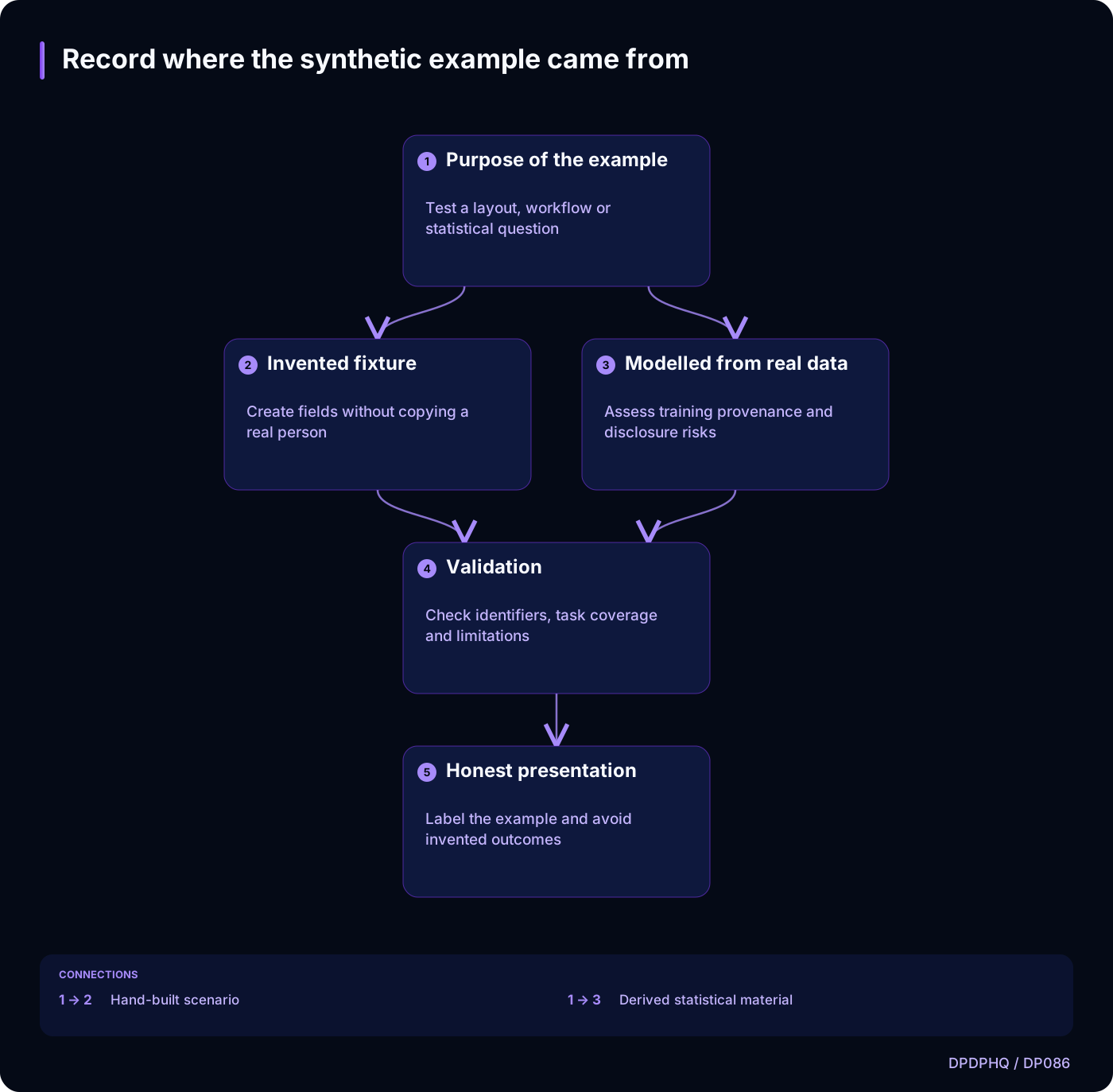
Text version of the diagram
- Purpose of the example: Test a layout, workflow or statistical question
- Invented fixture: Create fields without copying a real person
- Modelled from real data: Assess training provenance and disclosure risks
- Validation: Check identifiers, task coverage and limitations
- Honest presentation: Label the example and avoid invented outcomes
- Purpose of the example → Invented fixture: Hand-built scenario
- Purpose of the example → Modelled from real data: Derived statistical material
- Invented fixture → Validation
- Modelled from real data → Validation
- Validation → Honest presentation
Sources and reading context
These references support the original 22 October 2026 research. Source links and the date above make the scope of this article explicit.
- Digital Personal Data Protection Act, 2023 · section 2(t)
Identifiability test
- Commencement notification for provisions of the DPDP Act · paragraph (c)
Dates substantive duties
- NIST SP 800-188: De-Identifying Government Datasets: Techniques and Governance · Synthetic datasets and disclosure-risk assessment
Distinguishes a synthetic label from evaluated privacy