Education and children · DP068
Schools should separate learning records from promotional activity
Keep educational records, safety-related processing and promotional activity distinct in school systems and staff access.
Research cutoff: . This dated explainer is general information; check the linked instruments and your circumstances before acting.

A school may hold attendance records, teacher observations, assessment results, photographs and parent contact details in connected systems. That connection can help staff support a student. It can also make it easy for a marketing team to receive information that was collected for a very different reason.
Do not treat the student record as one undifferentiated resource. Start by separating the purposes the institution performs and the people who need access for each purpose.
Identify the educational task
A teacher may need learning progress and relevant support information. An administrator may need enrolment status and a parent contact. A publicity team may need only an approved asset and its publication conditions. Sharing the same institutional employer does not make every field necessary for every role.
As of 22 October 2026, the relevant substantive DPDP duties are scheduled for 13 May 2027 under the commencement notification. The future sections 5, 6 and 9 will shape the notice, consent and children assessment. Rule 6 will include access controls and related safeguards. Mapping purposes and views now is practical preparation for those obligations.
List the activities separately: teaching, assessment, attendance, safety, administration, optional events, public promotion and partner communications. For each, identify the relevant data, processing route, recipients and review event. Avoid a single purpose called ‘school operations’ that hides every difference.
Read the education exception narrowly
Rule 12 and Fourth Schedule Part A, item 3 provide a conditional exception for an educational institution, with the stated condition addressing tracking and behavioural monitoring for its educational activities or the safety of enrolled children. The exception affects section 9(1) and 9(3) within its scope. It is not a blanket exemption for all school activity or all education businesses.
It also does not remove section 9(2)’s restriction on processing likely to harm a child’s wellbeing. A school still needs to examine what a feature does, why it is needed and whether the exact conditions apply. Merely calling a campaign educational does not establish that it falls within the exception.
Record that assessment before relying on the exception. If the activity changes, revisit it. A safety tool repurposed to evaluate marketing audiences is not automatically governed by the same reasoning.
A hypothetical annual-results campaign
A school wants to publish a campaign celebrating examination results. The teaching team holds detailed marks, teacher comments and support notes. The publicity team asks for an export of the full results database so it can choose stories.
The school instead defines the intended publication, assesses the relevant permission route and creates a limited working set of approved material. Personal support notes never enter the publicity workflow. The final asset is checked for the identifiers it contains, the agreed channels and whether a student’s participation has been treated as optional where appropriate.
The example does not assume that every public result or every publication has the same legal position. It shows why the assessment should start with the specific publication, rather than with the convenience of a complete export.
Prevent secondary use through system design
Create views that match responsibilities. Separate campaign exports from learning records, and avoid broad shared folders that grant access because somebody once needed one document. When a supplier supports both learning and communication functions, ask whether configuration can keep purposes and permissions distinct.
Use synthetic records to test a change. Can a publicity user see private comments? Does an event-registration form add parents to a general promotional audience? Can a teacher accidentally publish an internal note through a shared link? These tests examine the actual path, not just the policy wording.
Keep an accountable owner for changes to the data flow. A new integration or a revised export can undo a carefully designed separation without changing the main student database.
Give staff a usable answer to informal requests
Staff need to know what to do when a colleague asks for ‘the latest student list’. Ask which task the list supports, which fields are needed and who will receive it. Provide a route for a limited approved export when appropriate, rather than relying on staff to choose between unrestricted sharing and refusing every request.
Review retained campaign working copies after the activity ends, alongside applicable retention requirements. A list created for one event should not become an unexplained long-term resource.
The recurring failure is assuming that a familiar institution has only one purpose. Clear separation lets teaching and administration continue while keeping optional publicity and new uses visible enough to assess properly.
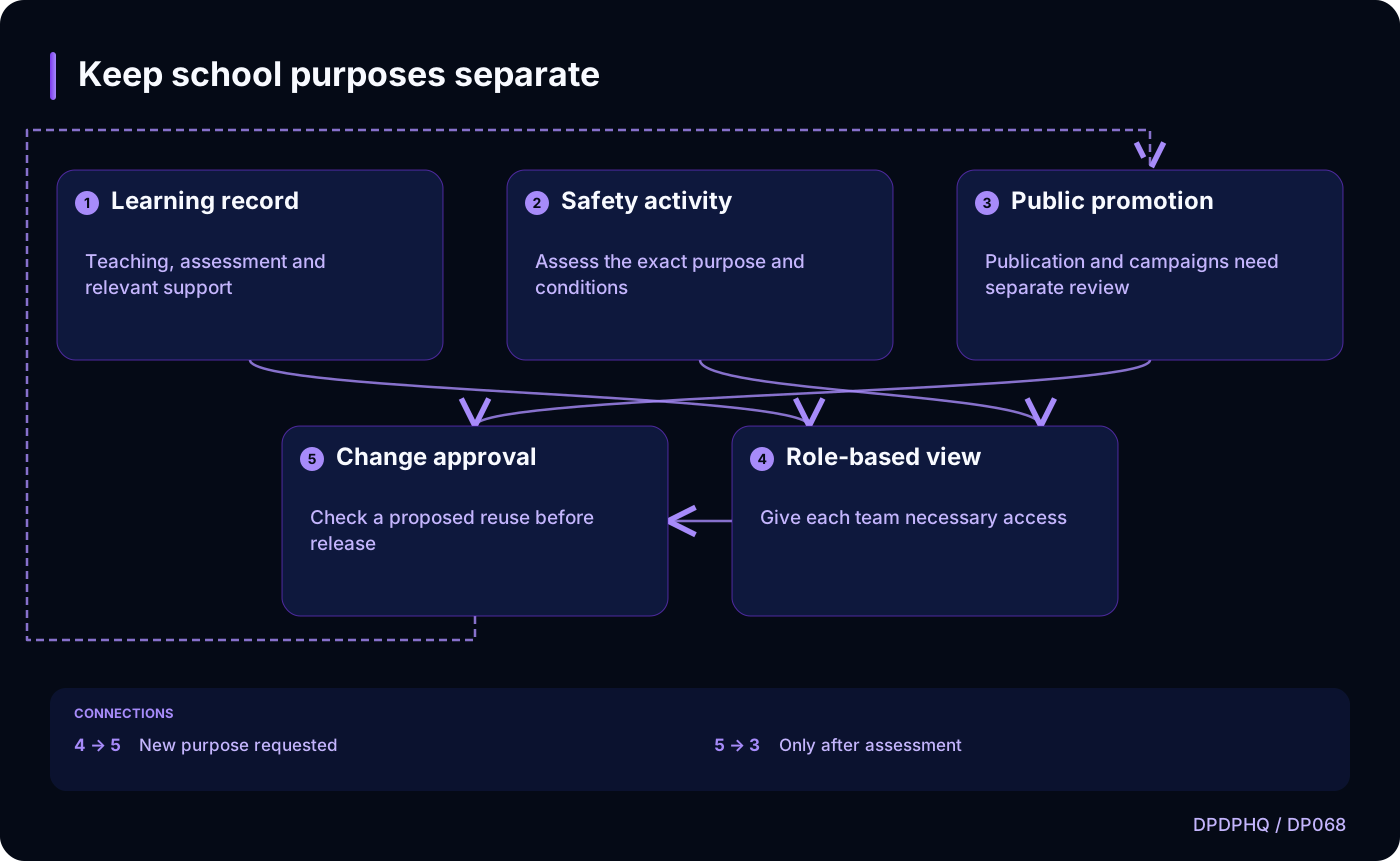
Keep school purposes separate
Text version of the diagram
- Learning record: Teaching, assessment and relevant support
- Safety activity: Assess the exact purpose and conditions
- Public promotion: Publication and campaigns need separate review
- Role-based view: Give each team necessary access
- Change approval: Check a proposed reuse before release
- Learning record → Role-based view
- Safety activity → Role-based view
- Public promotion → Change approval
- Role-based view → Change approval: New purpose requested
- Change approval → Public promotion: Only after assessment
Sources and reading context
These references support the original 22 October 2026 research. Source links and the date above make the scope of this article explicit.
- Commencement notification for provisions of the DPDP Act · paragraph (c)
Dates substantive obligations
- Digital Personal Data Protection Act, 2023 · sections 5, 6, 9(1) to 9(3)
Consent and child wellbeing framework
- Digital Personal Data Protection Rules, 2025 · rule 12; Fourth Schedule Part A item 3; rule 6
Education exception and safeguards